
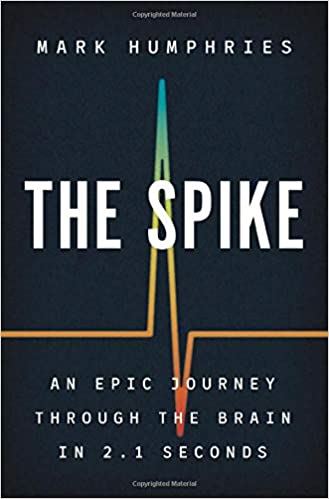
Mark and I discuss his book, The Spike: An Epic Journey Through the Brain in 2.1 Seconds. It chronicles how a series of action potentials fire through the brain in a couple seconds of someone’s life. Starting with light hitting the retina as a person looks at a cookie, Mark describes how that light gets translated into spikes, how those spikes get processed in our visual system and eventually transform into motor commands to grab that cookie. Along the way, he describes some of the big ideas throughout the history of studying brains (like the mechanisms to explain how neurons seem to fire so randomly), the big mysteries we currently face (like why do so many neurons do so little?), and some of the main theories to explain those mysteries (we’re prediction machines!). A fun read and discussion. This is Mark’s second time on the podcast – he was on episode 4 in the early days, talking more in depth about some of the work we discuss in this episode!

Timestamps:
0:00 – Intro
3:25 – Writing a book
15:37 – Mark’s main interest
19:41 – Future explanation of brain/mind
27:00 – Stochasticity and excitation/inhibition balance
36:56 – Dendritic computation for network dynamics
39:10 – Do details matter for AI?
44:06 – Spike failure
51:12 – Dark neurons
1:07:57 – Intrinsic spontaneous activity
1:16:16 – Best scientific moment
1:23:58 – Failure
1:28:45 – Advice
Support the show to get full episodes, full archive, and join the Discord community. The Transmitter is an online publication that aims to deliver...
Support the show to get full episodes and join the Discord community. Check out my free video series about what's missing in AI and...
Find out more about Steve at his website. I discovered him when I found his book chapter "What Can AI Get from Neuroscience?" in...